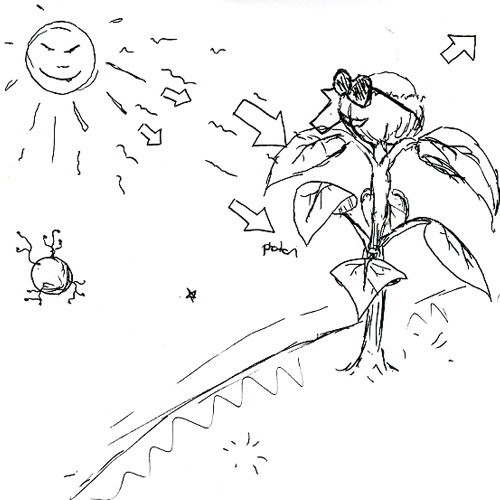
In the search for life plants' colours has become a focus of attention in a recent research conducted at the Virtual Plant Laboratory. "The dominant color of photosyntesis could be yellow, or orange or maybe red," Nancy Kiang, a biometeorologist at NASA's Goddard Institute for Space Studies explains "I think it is unlikely that anything will be blue-and, of course, green plants are also possible, since that's what we have here."
The reason why this studies unusual comes down to the high-level of interdisciplinary methods used. This includes the type of photons given off by a main-sequence star at a particular stage of its life and the depth of water in aqueous planets.

During photosynthesis plants take up energy from light (the sun). On earth, plants have an affinity towards using the blue and red part of the spectre that is rich in energy and absorbed plants. The remaining green part of the spectre is not needed and reflected hence we see plants as green or below water as red (seaweed).
On other planets different colours may dominate the spectre and cause plants to have other preferences to what they absorb and reflect.
In H.G.Wells' book "The War of the Worlds" (1898) he described unrestrained by atmospheric models Mars as a "vivid blood-red" kingdom of vegetables.
Plants growing on other planets are likely to be coloured the whole spectrum of the rainbow except for blue, researchers have concluded. Two studies carried out on the likely appearance of extra-terrestrial undergrowth suggest that it is as likely to be red or yellow as green.

By analysing the spectrum of light available from stars, the study shows, astronomers will know what sort of colours to look for that would indicate plant life on any orbiting planet. Blue, however, is an unlikely colour for alien plantlife as it is an energetic colour that makes it particularly valuable as a source of energy for plants through photosynthesis, making it far more likely that they would absorb rather than reflect it.