Dr Laura Cinti and Howard Boland were invited to present their research and artworks being undertaken at C-LAB.
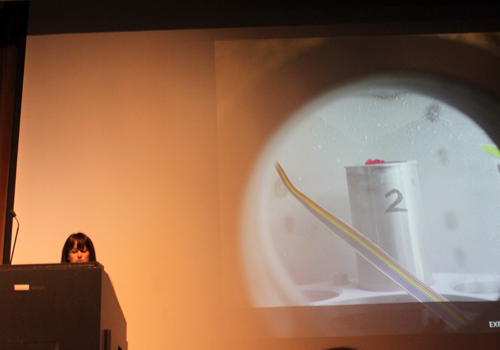
Laura introduced C-LAB as a research-focused art-science collective and organisation.
The presentation focused Laura and Howard's shared critique and discourse that deals with how artists working between the domains of art and biology, particularly those employing biotechnology, have been effective at producing speculative and dramatic living displays focusing on aesthetics and ethics. However, there is a need for artists to take into account the biological meaning and knowledge processes, which have so far been overshadowed by cultural ideas and themes that play little, if no role, on a biological or biochemical level.
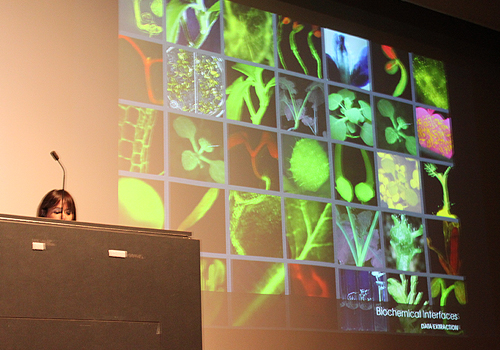
Laura discussed her doctoral research (2011, UCL) that included probing scientific possibilities of having living (non-specialised) plants respond directly and visibly to touch. Drawing inspiration from recent and novel biomedical applications conducted at UCL Centre for Advanced Biomedical Imaging, where iron oxide nanoparticles were manipulated using magnetic fields and used as 'smart delivery systems' to guide stem cells inside living organisms to sites of cardiovascular injury, she developed an experimental approach of having plants internalise these nanoparticles.
The outcome, an artwork titled Nanomagnetic Plants, explores how movements can be actualised in plants and this was the first demonstration of magnetically actuated plants.
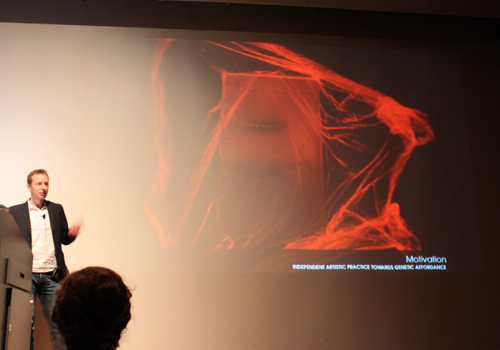
Howard spoke about his doctoral research and institutional challenges facing hybrid practitioners in articulating scientific knowledge processes within the humanities. He argued that what is captured in the living and its processes can move beyond cultural aesthetics and open new ontological and cultural spaces that breakdown anthropomorphism, or at least better understand the material we are working with.
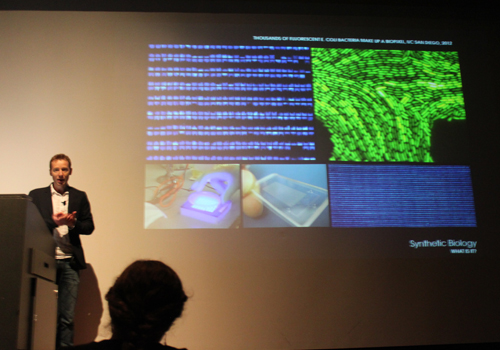
Through his daily practice at the molecular laboratory at University of Westminster, he has developed several works including Stress-o-stat, a work that emerged through a series of experiments that looked at visually capturing (oxidative) stress in bacteria as light.
In another work, Banana Bacteria, he transformed a genetic construct developed by a team at MIT capable of converting an alcohol (isoamyl) into an ester (isoamyl acetate or banana oil) into an odourless bacterial strain and grew this in an odourless media with a small amount of alcohol. The work allows audience to experience a strange and confusing sensation of bacterial smelling like banana.
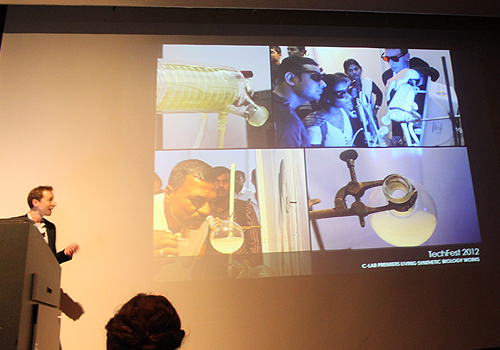
He has also explored non-modified system such as sludge bacteria from sewage capable of degrading textile dye as a way of generating 'disappearing' or Transient Images. Utilising bottles containing azo dyes (textile dye), he varies the inoculum resulting in images appearing as the dye degrades and disappears