The six-day exchange laboratory workshop on Synthetic Biology began with an introduction by organisers (Nicola Triscott - The Arts Catalyst, Alexander Daisy Ginsberg - Synthetic Aesthetics, Oron Catts - SymbioticA) and participants.
Dr Jane Calvert (Synthetic Aesthetics), a social scientist, gave an overview of the interdisciplinary field of synthetic biology - an emerging research area utilising engineering and bioscientific approaches to create, or redesign, living biological parts (i.e. biofuels, antimalarial drugs). She focused on ambiguities associated with the term ‘synthetic’, synthetic biology’s brief history, its approaches (i.e. parts-based approaches; genome-level work; protocell creation) and the differences between genetic engineering and synthetic biology.
Catts began by pointing out that Joe Davis’ seminal work, Microvenus (1995) (where synthetic molecules of DNA were presented as art) was fabricated prior the controversial synthetic biologist/entrepreneur, Craig Venter, inscription of his own name into a bacterial genome. Catts put forward questions of openness and access surrounding this technology, the ever-shifting perceptions of life and, importantly, the ethical issues.
Professor John Ward's (UCL organiser) talk ‘Microscopic Workhorses’ provided an introduction to bacteria, particularly E.coli (a minor inhabitant of our large intestine), the workings of ‘molecular machinery’ and recombinant DNA methods. 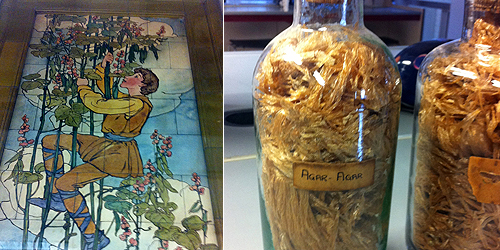
Left: Picture hanging in the laboratory, Jack and the beanstalk mosaic (one of my favourite childhood stories after The Emperor’s New Clothes) Right: Professor John Ward’s bottles of seaweed. Agar (growth medium to culture bacteria) is made from polysaccharide from seaweed.
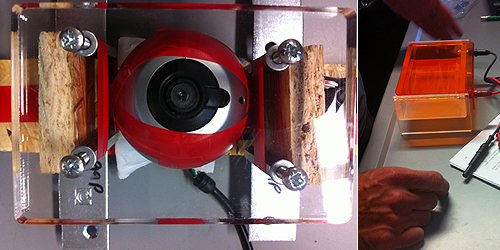 After Catt’s DIY talk, we were assigned into groups to build various lab equipment: microscope (left), PCR, incubator, gel box (right) and centrifuge.
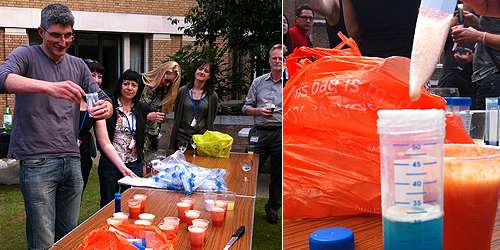
This was followed by (early) evening drinks…. a cocktail of nucleic acids.