Dr Alistair Elfick’s talk on ‘BioBricks’ - ‘Biology as Technology: United under a Standard’ - introduced the notion of standardisation using examples from British Standard’s preparation of a liquor of tea for use in sensory tests, array of colour palettes, screw thread, plugs, systems biology, transistor–transistor logic (TTL) and non-contextual data standards – genomic data – such as such as nucleotide sequence data (i.e. fasta, agp) and protein sequence data.
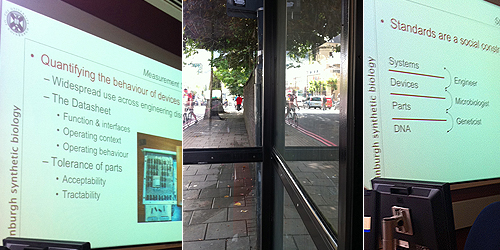
Although standards may limit flexibility of technology (i.e. limited ability for ‘standards’ to respond to change/outmoded standards can hamper developments), ‘standard’ protocols are applications/tools we can use and develop. Specifically, for synthetic biology, that involves standardising the genetic building blocks (BioBricks) and can be ordered from a registry of parts (similar to open source software) to build a genetic devices (i.e. E.coli bacteria changing their pH in the presence of arsenic). For such developments, a common standard is necessary.
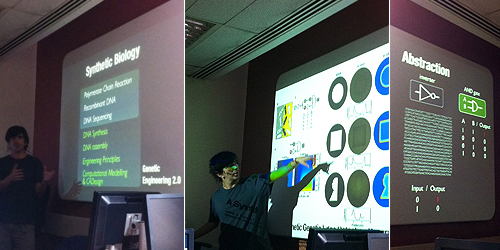
Dr Fernan Federici’s talk, ‘Mass Construction – Gibson Assembly’, provided an introduction to synthetic biology (from a scientific perspective), its increasingly interdisciplinary aspects, and a technical overview of the DNA assembly technique called Gibson Assembly - a ‘high-efficiency DNA end-linking technique developed by David Gibson at the J. Craig Institute in 2009 - Enzymatic assembly of DNA molecules up to several hundred kilobases.
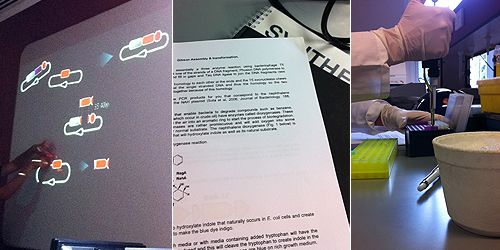
Following Federici's talk, we undertook a lab practical involving the Gibson Assembly technique. 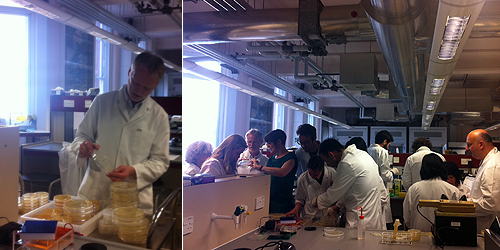
Reveiwing our plated bacteria that we collected from our environment and bodies. 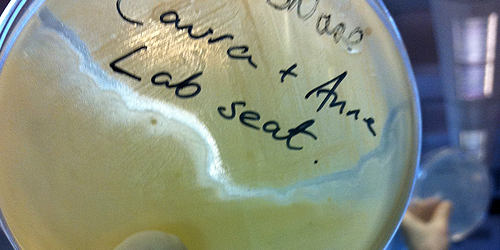 bacterial growth from our lab seat (!)