A bioreactor is normally thought of as a large fermentation chamber used to grow bacteria or yeast. Industrial scale bioreactors are used to produce substances like antibodies and vaccines for pharmaceutical companies. However, there has been a growing need to also create miniature bioreactors to avoid requirements such a large quantities of nutrients, reagents and allow chip-based control of the population. The construction relies on the use of a biofilm - an aggregation of microorganisms.
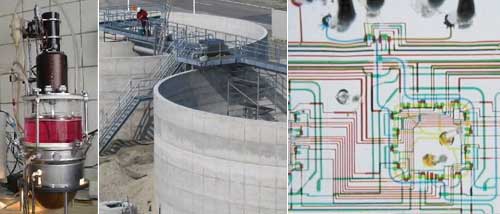
The problem is that the biofilm interferes with the bioreactor operation by shedding progeny (offsprings) into the bulk culture creating mixed cultures.
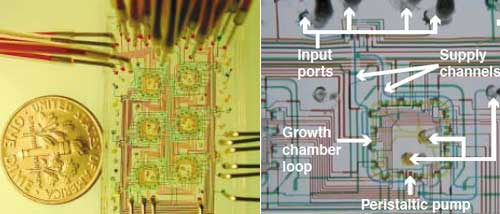
To solve the problem, a group of researchers at Caltech have created a technique using synthetic biology to program in a population control using a tiny plumbing network. Their device contains six independent 16 nanoliter reactors (microchemostat) where plankton can grow semicontinuous without producing a wall of progeny. The researchers could then monitor the culture in-situ, real-time, non-invasive, automated with a single cell resolution using a microscope.
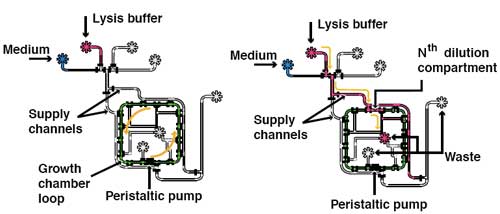
The tiny reactor setup pumps fluid in and out of the tiny chamber, adding nutrient and removing waste - to some extent this is similar to a hydroponic plant growth system. More complex growth dynamic could be demonstrated using a synthetic population control circuit using a negative feedback system (quorum sensing).
When the circuit is ON - the cell density is broadcast by syntheses of AHL (acylhormoserine lactone). AHL causes the expression of a killer gene (lacZα-ccdB), thus causing the density to be regulated by controlling the death rate. To switch the circuit ON - isopropyl-b-D-thiogalactopyranoside (IPTG) is added - this reagent mimics allactose (but contains sulfur which prevents it from being destroyed) and triggers transcription of the lac operon. Thus, IPTG can be used to promote a gene of interest by replacing the lacZ gene with another - in this instance genes that produces AHL.

The steady-state of the system is established through the concentration of AHL. As the population increases so does the concentration of AHL, subsequently the expression of lacZα-ccdB at which time cell start to become filamented until cell death occurs. As cells start to die of the AHL concentration decreases until it reaches a threshold where the concentration is to low to affect expression of lacZα-ccdB and the population can again start to grow and the process repeats until an oscillating homeostasis is reached.
Using synthetic biology to control density is more difficult in large scale batches (3-50ml) as the regulation is lost after a short period (70 hours) whilst in the small population the regulation could be controlled for longer (200-500 hours). It is believed that the cause of this lost regulation is due to mutation. The researchers also noted that different strains of E.coli had variation in the oscillation towards steady-state - the origin of this variation remains unknown.
The technique and device used can offer a cheaper way of classifying phenotypical characteristics and facilitate output screening for chemical genetics and pharmaceutics.