Bose Research Institute, Calcutta
Life Movements in Plants (1918) 1: 2, 5-30
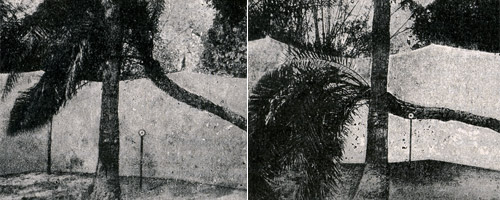
In the evening, while the temple bells ring calling upon people to prayer, this tree bows down as if to prostrate itself. It erects its head again in the morning, and this process is repeated every day of the year.
This tree, the Date Palm [Phoenix dactylifera] positioned itself near Faridpur in Bengal. Showered with offerings, visitations by pilgrims and considered miraculous.
Described as being rigid and fully grown with a 5 meter length trunk, Bose postulates that its inclination of 60° to the vertical results from displacement by a storm. The neck of this tree concaves to the sky in the morning and by the afternoon the curvature disappears, leaning forward bending its ‘back’ till the leaves are down.
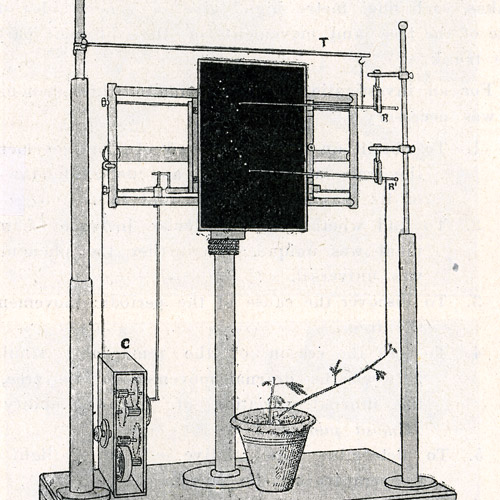
Bose’s investigation into this phenomenon resulted in series of experiments, which included recording movement of the tree, to see whether this movement was unique, find the cause of this movement, look into its similarities with other plants, demonstrate physiological character of the tree and discover physiological factor whose variations determine the directive movement.
Using an apparatus he constructed to automatically record the movement of trees and plants, the initial challenge lay in obtaining permission from the proprietor to attach this recording apparatus to the ‘Praying’ Palm. The proprietor had misgivings since the miraculous power of the tree might disappear as a result yet was convinced by Bose that the instrument was indeed made in India and that it would be attached by one of his research assistant who is a son of a priest.
Bose’s investigations recording the ‘Praying’ Palm showed that it exhibited a diurnal movement, where head erected in morning after which there was continuous fall which reached its climax in the afternoon with its head depressed and leaves pressing on the ground [after this the movement was reversed and maximum erection was reached again the following morning and so on.]
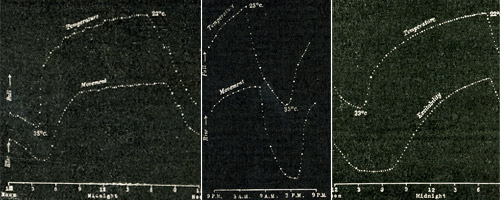
After experimenting with a different Date Palm he confirmed that the ‘Praying’ Palm movement was not a solitary, unique phenomenon but universal.
The tree’s movement was not seen to be affected by the periodicity of day and night but rather variation of temperature. The fall of temperature induced rise in the tree and visa versa.
Bose found that the excitability of the Sensitive plant, Mimosa pudica, did not remain constant. In the morning, period of insensibility in Mimosa [corresponds to the palm tree attains maximum height] and later in the afternoon it reaches its climax [again, corresponding to the palm tree which bends down at this time]. For the determination of periodic variation of excitability in the Mimosa, Bose devised an apparatus which emitted electrical stimulus of constant intensity which was applied to the plant every hour [day and night.] This showed that the variation of moto-excitability of pulvinus of Mimosa is a physiological function of temperature.
The movement is primarily determined by the modifying influence on temperature on geotropic curvature.
Finally concluding that the movement of the ‘Praying’ Palm is a thermonastic phenomenon. The tree, apparently so rigid, responds as a gigantic pulvinoid to the changes of its environment.
While presiding at my lecture on the subject, His Excellency Lord Ronaldshay, the Governor of Bengal, announced that a telegram had just reach him from his officer in Faridpur that “the palm tree was dead, and that its movements had ceased.”