Bios 4
The Bios 4 talk moderated by curator Antonio Cerveira Pinto gave a reflection on the relationship between science, technology, and art with the participation of artists taking part in the exhibition and other guests.
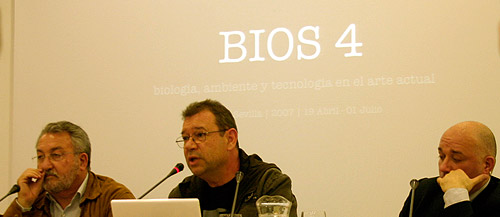
Antonio Cerveira Pinto
Antonio Cerveira Pinto explained his motivation behind the exhibition. Throughout the 20th Century artists have increasingly had a movement towards conceptualisations and their works become a reflection onto itself. What he sees as new in current movements including this exhibition is that artists are now showing real engagement with processes and material outcomes. This kind of materialization can act to reconnect the audience with contemporary art because it clearly reflects an experience of culture and zeitgeists.
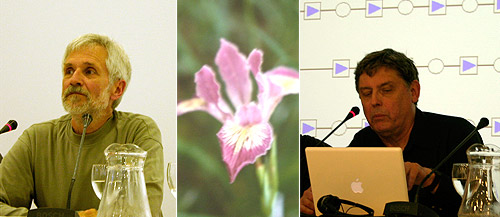
George Gessert
George Gessert was presented as one of the “padres” of the new art-science intersection. Gessert describes how his family moved from a city to the countryside when he was a child and the only art available to him was various ornamental Chinese and Japanese paintings on objects. Throughout his art education and in NY he tended to follow trends which were changing every week. After a period he began to explore natural processes using dabs of ink which led him to plants and then plant breeding that finally has reconnected him with the art he had experienced as a child.
Norman T. White taught himself electronics in the late 1960s and used this to produced the work “First Tighten Up on the Drums”. It is a rule based systems reminiscent but disconnected from Conway’s “Game of Life”. The work was brought by the Museum in Toronto and shown for a short period where after it has been stored in basement of museum that is until Bios 4.
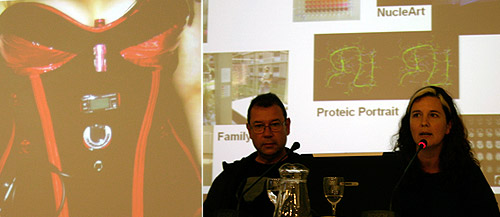
Marta de Menezes
Marta de Menezes held a general presentation which included her previous works and the research network Ectopia she has developed where artists can engage and connect with science and scientists throughout Portugal.
Cynthia Verspaget and her collaborator were showing their work Incubra abroad for the first time. Unfortunately the work had gotten lost during transportation and was thought to be somewhere in Spain. We were glad to hear about the interesting work which was a special piece of clothing in the form of a corset in which the body heat from the wearers breasts was central to produce a sexy wearable incubator.
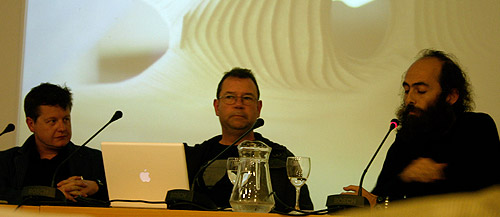
bio-architects
Two Spanish bio-architects gave their views on the changing landscape of architecture. Their discussion flagged how there has been a large amount of virtual models created and the many failures to metamorphose these. They stressed the importance on processes of materialization that can clearly formulate the outcome.
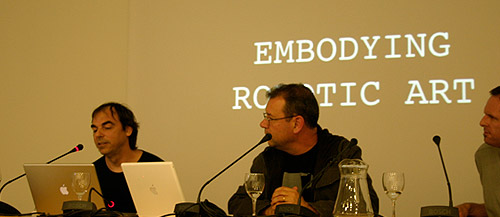
Mark Cypher
Mark Cypher gave a presentation, despite being jet lagged, in which we were provided with an overview of his work Biophillia.
Bill Vorn told a story of his background from pop music to robotics. He showed various robotic works he had created around the concept of hysteria and methods used to give his robots more organic motion.
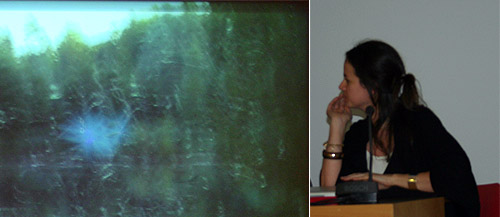
Laura Cinti
Laura Cinti showed a video of the Martian Rose experiment in which two miniature red roses were exposed to Martian environment using a planetary chamber. As the video wasn’t part of the installation, she commented on the video and shared this footage with the audience, many for the first time.
Ursula Damm explained her work and showed video footage of an experiment. Her work looked at swarm behaviour in midges. She had devised a swarm attractor that attracted midget swarms using audio that assigned pitch and frequency to temperature and specie. The device enabled her to attract various midget species. Her work also shows tracings of these attractions.
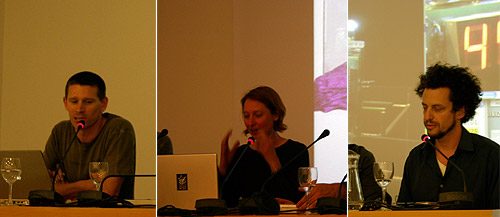
Philip Ross
Philip Ross gave a background which included being a chef for 12 years and how he has found himself cynical perhaps without irony. He addressed the issues when dealing with life and setting up an exhibition of this type and the things that can go wrong. His works (also for this exhibition) often deals with autonomy and producing self-sustaining systems.
Andy Gracie explained his interest in having systems that communicate and allowing exchange of messages between organisms using technology as an interface.
Finally, Amy Youngs interestingly stated the insignificant role technology played in her works, rather its became an add-on to make it a bit more exciting. She showed some of her humorous and strange work which included cricket where the crickets lived in a simulated house with resonant imagery of their original habitat. The audience was captured on video and shown to the crickets on a miniature TV. A video on her exhibited work (a table with a compost container in the middle with an infrared camera and embedded monitor) showed how audience could eat with worms and watch them feeding and once the meal was over - feed them remains.