Living Mirror
Bio-computational imaging system
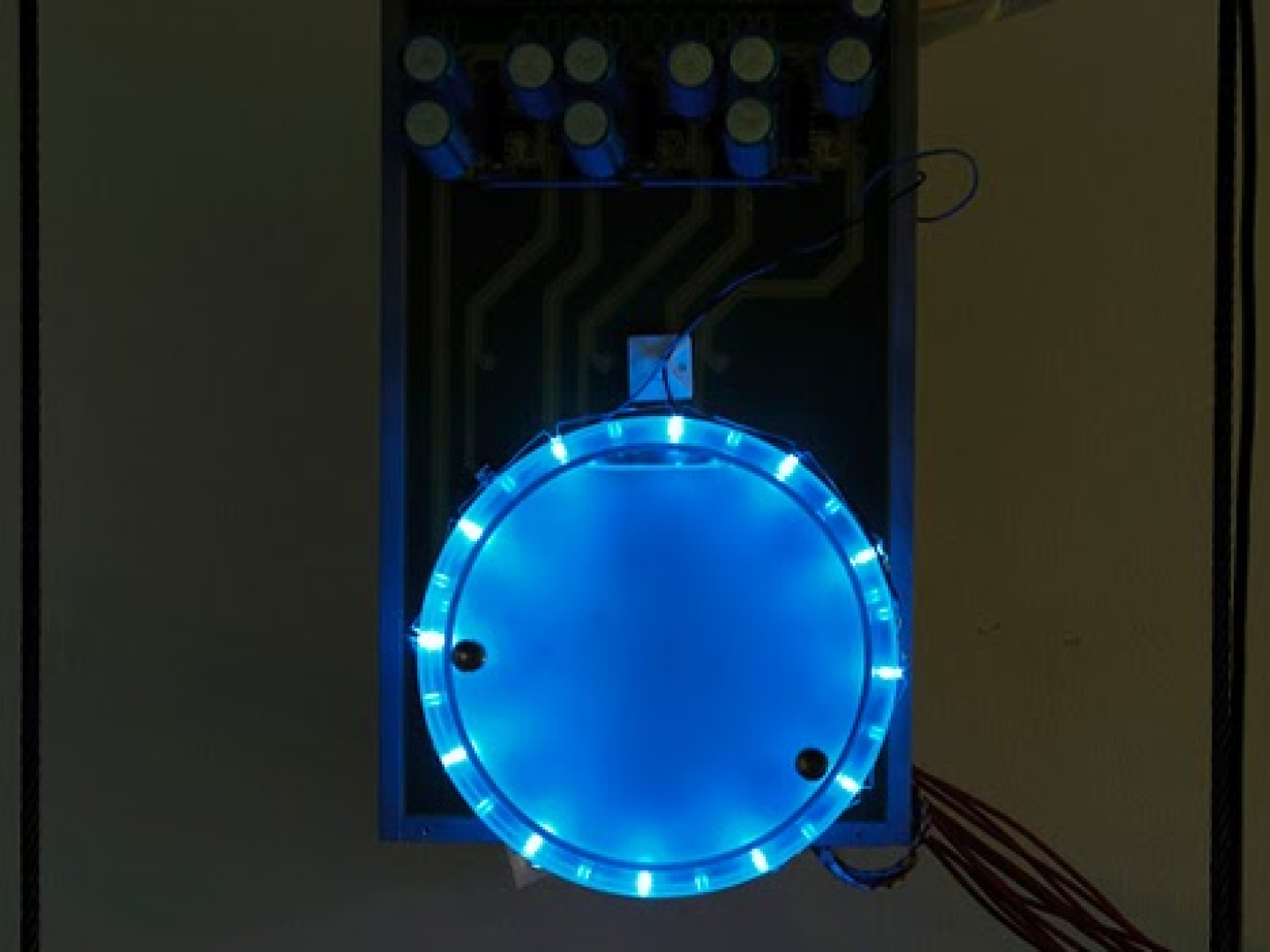
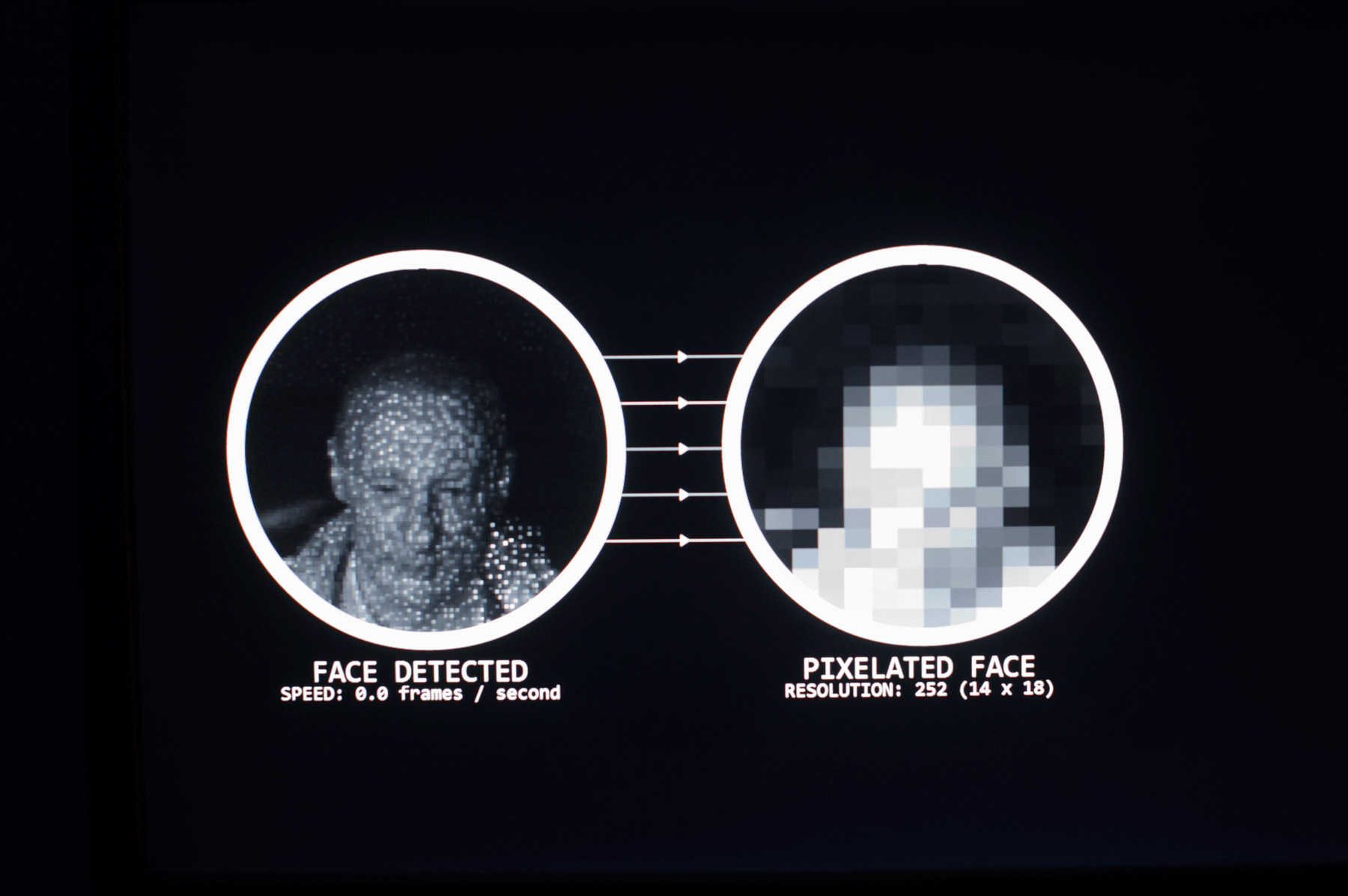
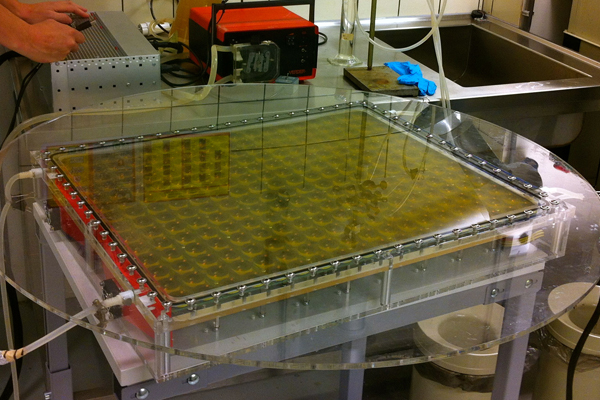
A large liquid display containing bacteria culture is exposed to fluctuating magnetic fields that cause bacteria to rotate synchronically, scatter light and create visible shimmers. Using a kinect sensor to capture image of audience faces and translate these into small pixelated icons, numerical values from darker and lighter pixels are used to activate fluctuation in specific magnetic coils and programmatically harmonises hundreds of light pulses - caused by bacteria synchronically rotating - to re-create the image inside a liquid culture.
Biological Mirror
Concept
As a liquid biological mirror, Living Mirror draws on the idea of water as our first interface predating today’s screen based digital technologies. It points to the myth of Narcissus who fell in love with his own image by believing it was someone else in the water reflection. Drawn into the image, he tragically drowned a reminder of how we continue to immerse ourselves in similar mirrors as we extend our identity into the virtual. Simultaneously, the work highlights how contemporary science has shattered the idea of our own body by recognising that we are mostly made up of nonhuman bacterial cells. These ideas have shaped digital and biological understandings of our human self and are technically and conceptually reflected in Living Mirror.
Bacterial Imaging System
From digital to biophysical
Living Mirror is the first imaging system demonstrating real-time interaction with living bacterial cells. It makes use of bacterial cells to form images by capturing and transforming these from a digital to a biophysical space. Observing bacteria responding in real-time is a highly unusual experience without the use of visual aids such as microscopes and the work is therefore an ambitious undertaking that integrates three complex layers of wetware, software and hardware to produce living shimmering pixels (bacterial cells) with the aim of forming portrait images or patterns.
Magnetotactic bacteria
Imaging
The ability for these bacteria to biomineralise or incorporate magnetite as small vessels inside their body gives them an ability to navigate like tiny compasses. This rather curious and stringent living condition makes them challenging to cultivate. By introducing changing fields, bacteria rotate synchronically causing light to scatter as a visible shimmer inside the liquid. Multiple pulsating waves of bacteria are made to form pixelated images or patterns using tiny electromagnetic coils that shift magnetic fields across surface areas.
ACKNOWLEDGEMENTS
Credits

This project benefited from a collaborative partnership with Professors Bela Mulder and Tom Shimizu at AMOLF a leading biophysics institute based in Amsterdam.

The proposal was selected as a winning entry for the Designers and Artists for Genomics Award (DA4GA).


An initiative of the Netherlands Genomics Initiative (NGI),The Centre for Society and Genomics and Waag
and hosted by the Naturalis Biodiversity Center.

Howard Boland and Laura Cinti undertook a six months residency at AMOLF. We’d like to express our sincerest thanks to:
Professor Bela Mulder, Head of Theory of Biomolecular Matter group
Professor Tom Shimizu, Group Leader - Systems Biology
Marco Konijnenburg, Head of Software Engineering
Dirk Jan Spaanderman, Precision Engineer
Duncan Verheijde, Head of Electronics Engineering
& everyone at AMOLF who made this research possible!
Also special thanks to Per Staugaard, Biosafety Training and Consultancy, for his advice in securing a permit for exhibiting Genetically Modified Organisms (GMOs). The Living Mirror successfully obtained a GMO Permit for the first time in the Netherlands, to officially exhibit GMO artworks in public settings, officially published by Bureau Genetisch Gemodificeerde Organismen (Bureau GGO).
Living Pixels
Videos
The videos show cultures growing, being monitored, and responding to magnetic stirrers, coils, field switches, and prototype interfaces, revealing how bacterial alignment, motion, and light scattering change in real time as magnetic intensity and direction are adjusted. Across continuous vessels, coil tests, polarisation experiments, and geometric grid prototypes, the footage traces the translation of microscopic biological processes into visible, emergent forms.